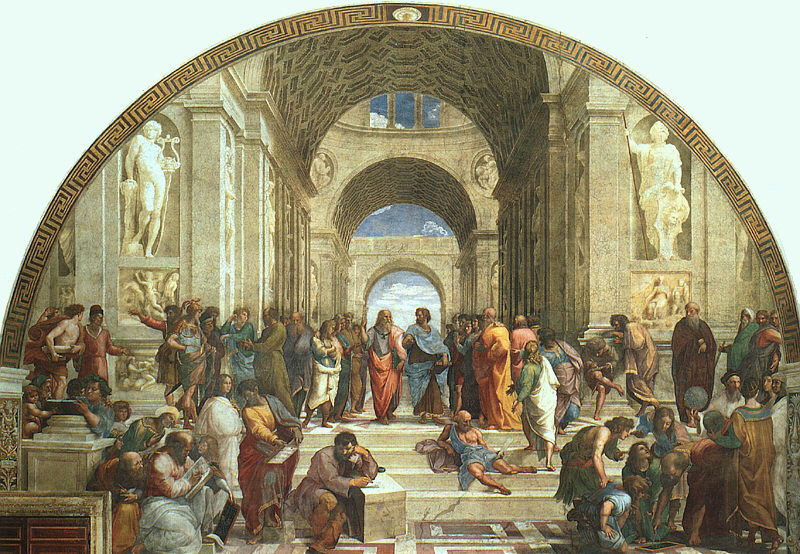
(Raffaello Sanzio: La Scuola di Atene
Palazzo Vaticano, Stanza della Segnatura)
EPISTEME FORUM
[Diversi corrispondenti mi hanno segnalato la "nostalgia"
nei confronti di Episteme
, e per mantenerne allora in
qualche modo vivo il ricordo costruisco
questa pagina web, pur con l'impegno
ridotto dovuto al volontario pensionamento
anticipato - stanco di come è stata ridotta
l'università da una serie di improvvide
riforme, ispirate al dilagante "pragmatismo"
angloamericano...
UB, gennaio 2006]
_____________________________________________________________
1 - Alberto Bolognesi
L'Origine dei Quasar e la Recessione
delle Distanze
L'astrofisico Alberto Bolognesi
offre gentilmente questa interessante
"appendice" al suo articolo pubblicato
nell'ultimo numero di Episteme
. Ne offriamo subito
qualche stralcio:
"Ciò demolisce l'assunto fondamentale della cosmologia
per il quale lo spostamento verso il
rosso degli oggetti cosmici è
causato dalle loro velocità di
recessione radiale conseguenti all'espansione
dell'universo. [...] Nel raggelato
imbarazzo di chi ha fatto dipendere l'onorabilità
della scienza dalle distanze di questi oggetti,
tali osservazioni vengono sottratte
alla comunicazione al grande pubblico secondo
un'etica che Noam Chomsky paragona 'a uno
stupro della conoscenza da parte dell'establishment'.
E' ciò che consente poi agli operatori
del circo mediatico di consolidare i paradigmi
e di eliminare dai quiz ad alto share per adolescenti
quelli che non sanno 'che l'universo è
sorto da un'immane esplosione avvenuta circa
15 miliardi di anni fa e che al momento della sua nascita
aveva le dimensioni di una capocchia di spillo'.
[...] se siamo disposti ad accordare alle osservazioni
almeno lo stesso credito che si concede alle teorie,
dovremmo dire tranquillamente che l'espansione dell'universo
è un FALSO PROVATO e che il sistema
di divulgazione accademico difende strenuamente
un'ipotesi inadeguata sull'origine della Natura".
Un altro articolo del Dott. Bolognesi sul giornale
on line
diretto da Maurizio Blondet
(
http://www.effedieffe.com/index.php
):
English
version:
The Submerged Schism
(pdf file)
18 Marzo 2008
Siamo veramente grati al Dott. Alberto Bolognesi che ci permette ancora
una volta di mettere a disposizione dei lettori un suo recente
articolo su talune assurdità della cosmologia contemporanea...
"Il monumento al creazionismo assoluto, la teoria del Big Bang, suppone
che 14 miliardi di
anni fa non ci fosse nemmeno il cielo. Non
c'era alcuno spazio, alcuna estensione preesistente,
nemmeno uno spazio topologico che potesse contenere
anche un solo atomo di idrogeno. La materia cosmica
così come lo spazio e il tempo vennero assolutamente
creati dall'esplosione infinitamente calda
e densa di un punto di raggio zero che precedentemente
non esisteva. La bomba perfetta e autocontenuta
della genesi che almeno nelle sue fasi iniziali si
propagò dall'interno di sé stessa a
velocità infinita. E l'universo fu. Questa bubbola
termodinamica celebrata come una scoperta scientifica
e inculcata fin dalle scuole elementari è condivisa
oramai da ogni branca del sapere istituzionalizzato, dalla
fisica alla chimica, dalla matematica alla filosofia, dall'astronomia
alla biologia. E' la leggenda metropolitana della Creazione,
la Magna Charta dell'inciucio cosmologico, la pietra
filosofale che attraverso un formidabile circuito di autoreferenzialità
ha potuto attirare grandi quantità di
danaro pubblico e decuplicare il numero degli abilitati
alla ricerca... "
29 gennaio 2009: Siamo lieti di poter presentare un altro
interessante breve scritto del Dott. Alberto Bolognesi, relativo
a un incontro con Sir Fred Hoyle(Bingley,
24 giugno 1915 - Bournemouth, 20 agosto 2001), avvenuto
a Bournemouth nel 1992.
Marzo 2009: E' finalmente nelle librerie il libro di Halton
Arp: "SEEING RED - L'Universo non si espande" (Jaca Book,
Milano), edizione italiana a cura di Enrico Biava e Alberto
Bolognesi, con un poscritto dell'autore.
- - - - -
12 Novembre 2009: Esprimiamo ancora una volta
la nostra viva gratitudine al Dott. Bolognesi perché ci
permette di leggere subito la versione inglese del suo ultimo articolo,
che viene simultaneamente pubblicato nell'ultimo numero di Coelum
.
ATTAINABLE UTOPIAS
(LE UTOPIE REALIZZABILI
)
(pdf file)
Nel Ritorno al Mondo Nuovo (1958) lo scrittore
inglese Aldous Huxley delinea gli scenari derivanti da un'autocrazia
gestita esclusivamente da scienziati. "Gli uomini e le donne verrebbero
allevati nell'amore dello spirito di servizio e mai sognerebbero
la rivoluzione. Non si vede per quale buona ragione -conclude con
laconicità agghiacciante- dovrebbe mai crollare una dittatura
integralmente scientifica".
Se quella predizione almeno per quanto riguarda la Cosmologia
non si fosse nel frattempo realizzata, non si capirebbe perché
le uniche evidenze rigorosamente osservative (galassie di età
e di morfologie differenti, quasar e altri oggetti visualmente connessi
a sistemi con redshift altamente discordi, etc.) siano state liquidate
senza alcun approfondimento o verifica accurata ...
In Brave New World Revisited (1958), English writer
Aldous Huxley outlined a series of possible scenarios that might result
from an autocracy governed solely by scientists: "…most
men and women will grow up to love their servitude and will never
dream of revolution." With chilling brusqueness, Huxley concludes
that "…there seems to be no good reason why a thoroughly scientific
dictatorship should ever be overthrown".
If in the meantime this prophecy had not been fulfilled at
least in the realm of Cosmology, it would be impossible to understand
why the only examples of rigorously observational evidence (galaxies
of different ages and morphologies, quasars and other objects visually
linked to systems with highly discordant redshifts, etc) have been
written off without any further examination or accurate attempt at
verification ...
(Halton Arp, a sinistra, e Alberto Bolognesi)
- - - - -

Il 26 gennaio 2010 è scomparso Geoffrey Burbidge (1925,
Chipping Norton, UK - 2010, San Diego, USA), brillante astrofisico non
troppo "inquadrato" nelle mode cosmologiche correnti. Lo ricordiamo con
un necrologio di Alberto Bolognesi.
_____________________________________________________________
2 - Maurizio Michelini
Un test fondamentale per la teoria
della gravitazione
Un test fondamentale per la teoria
della gravitazione
(versione html)
Altri link ad articoli del Dott.
Michelini:
http://arxiv.org/ftp/physics/papers/0509/0509017.pdf
(The cosmic quanta paradigm fulfils
the relativistic mechanics,
improves the gravitation theory and originates
the nuclear forces)
http://arxiv.org/ftp/physics/papers/0509/0509097.pdf
(A fundamental test for physics:
the galactic supermassive obscure
bodies
http://www.arxiv.org/ftp/physics/papers/0607/0607136.pdf
(The Physical Reality Underlying the Relativistic
Mechanics
and the Gravitational Interaction
)
La Relatività Generale è messa in seria
difficoltà dalle recenti osservazioni al centro delle galassie a spirale
di masse oscure i cui effetti gravitazionali sulle stelle circostanti sono
pari ad alcuni milioni di volte quelli prodotti dalla massa solare.
... Recentemente è
stato proposto [14] un nuovo paradigma
fisico costituito da un flusso omogeneo
di quanti con lunghezza d'onda lamba-0
pari a circa 4x10 -35
(lunghezza di Planck), responsabili
della elevata densità di energia dello
spazio "vuoto". I quanti cosmici hanno questo
nome perché pervadono l'universo
penetrando attraverso le masse degli ordinari
corpi celesti.
(19th January 2009)
We are grateful to Dr. Maurizio Michelini for making at disposal of
our readers his following new very interesting paper.
Abstract.
In the proposed paradigm
the space is filled with a very high flux
Phi o of very small quanta
whose wavelength lambda 0
results equal to the Planck's length.
Since their energy E 0 = h
0 nu 0
is very small, the relevant quantum constant h
0 is enormously smaller than
the usual Planck's constant. Any particle shows
a little Compton's cross section sigma
i =A 0 m i
proportional to its mass, so these quanta
freely travel in space along large distances (cosmic
quanta). Colliding with matter the quanta impose the
principles of conservation of energy and momentum,
as well as the laws of relativistic mechanics and related
inertial forces. The strong equivalence principle,
in the version stating that both inertia
and gravitation come from a single phenomenon,
becomes the relevant test to verify the physical reality
of the cosmic quanta i.e. their capacity to explain the
gravitational interaction. The quanta colliding with
two masses give up a little momentum (E 0
-E 1 )/c which produces a
newtonian force pushing the masses each
towards the other. The quantity G = K 0
Phi 0 E 0
A 0 2 /4pi c depends
on the quanta characteristics, so the Newton's gravitational
mass no longer holds. However the most interesting
feature is that the new gravitational force depends also
on the quantum energy. For instance a mass facing a very
dense star, where the quanta undergo n collisions, receives
weakened quanta of energy E n < E
1 < E 0
which give the mass the momentum (E 0
-E n )/c >> (E
0 -E 1
)/c. This fact increases the newtonian G by the gravity
factor (n/a) >= 1 depending on the star mass and density.
For instance the gravity factor reaches numbers of 200-300
in the case of neutron stars, incrementing notably their
accretion capacity. This property may explain, in particular,
the mystery of the obscure galactic supermassive bodies whose
gravitational effects have been observed to rise up to 3.7x10
6 times the Sun effects.
Current gravitational theories are unable to give a convincing
explanation of this phenomenon.
(This paper
has been published in Apeiron , Vol. 14,
No. 2, April 2007)
(16th November 2008)
We are proud to present a new paper of Dr. Maurizio Michelini,
a continuation of the previous one.
The Common
Physical Origin
of the
Gravitational, Strong and Weak Forces
(pdf file)
Abstract.
Particles moving within the flux of micro-quanta filling the space
have been shown to obey the Relativistic Mechanics
and to undergo a gravitational "pushing" force with
G depending locally on the quantum flux constants. Due
to the very little quantum energy E o ,
the ratio E o / mc 2
equals about 10-50 so the collisions with particles
follow the optical reflection accurately. The simultaneous
micro-quanta hitting upon a nucleon are about 1050, a
high number due to the small wavelength which results close
to Planck's length. Along the joining line between two particles
there is a lack of incident quanta (missing beam) which determines
unbalanced collisions generating drawing forces
between particles by mutual screening. These forces increment
the particle energy, as shown for instance by the heating during
the gravitational contraction of the galactic gas globules
leading to protostars. This mechanism allows to predict that
observations of the thermal emission from major solar planets
may exceed the power received from solar light. When two particles
are very close, the mutual screening highly increments the missing
beam, giving rise to a short-range strong force which is of the
right strength to hold protons and neutrons within the atomic
nuclei. The belief that nuclear forces are "self-produced" by nucleons
is disproved. Proof is given for the structure of the simple Deuterium
nucleus. The same process originates also a short-range "weak" force
on the electron closely orbiting a proton, giving rise to the neutron
structure which undergoes beta -
decay. The mutual strong forces on a nucleon pair are equal,
but the weak force on the bound electron differs largely from the
force on the proton (breakdown of Newton's action and reaction symmetry).
(This paper
has been published in Apeiron , Vol. 15,
No. 4, October 2008)
- - - - -
2 dicembre 2009: Siamo lieti di presentare un nuovo importante articolo
di Maurizio Michelini (che sarà presto pubblicato su
Progress in Physics ), in cui si torna sul tema
della pushing gravity introducendo il nuovo concetto di
potenza gravitazionale .
Abstract.
Some major problems of physics, which remained unsolved
within classical and relativistic gravitation theories, are explained
adopting the quantum gravity interaction descending from the micro-quanta
paradigm. The energy source of the gravitational power Pgr
, which heats and contracts the Bok's gas globules harbouring the
future stars, is identified and defined as well as the gravitational
power generated on the solid/fluid planets. Calculations are carried
out to make the comparison between P gr predicted for the
solar giant planets and the measured infrared radiation power P
int coming from the interior. The case of planets with solid
crust (Earth, etc.) requires a particular attention due to the threat
to stability produced by the thermal dilatation. An analysis is done
of the Earth's planetary equilibrium which may be attained eliminating
the temperature rise through the migration of hot internal magma across
the crust fractured by earthquakes. The temperatures observed up to 420,000
years ago in Antartica through Vostok and Epica ice cores suggest the possibility
that the Earth gravitational power P gr may be radiated
in space through these temperature cycles (Glacial Eras). In this general
frame the Earth's high seismicity and the dynamics of Plate tectonics
may find their origin.
_____________________________________________________________
2 bis - Ancora su possibili spiegazioni della gravità
alla Le Sage - De Pretto - Michelini
A proposito di studi interessanti sulla natura fluida dello spazio
fisico reale, e sulla pushing gravity, ci
sembra di far cosa utile ai lettore segnalando loro le seguenti due pagine
web:
- La pagina dell'Ing. Stefano Gusman
http://marius-gravity.blogspot.com/
- La pagina dell'Arch. Mario Ludovico
http://www.mario-ludovico.com/
dalla quale è possibile scaricare tra l'altro un intero
libro: Vacuum, Vortices and Gravitation
.
_____________________________________________________________
3 - Umberto Bartocci
Prendendo spunto dalla domanda di cui in titolo, l'articolo
discute più in generale la fondazione
(dualistica) della matematica,
contrapponendo quella trascendentale
di Kant a oltre un secolo di " nichilismo
ontologico". Aggiungiamo una breve sintesi
della collegata conferenza: "Spunti critici
sulla filosofia della matematica e della
fisica del XX secolo, e su talune diffuse interpretazioni
'scettiche' del teorema di incompletezza
di Goedel" (Università degli Studi di
Perugia, Dipartimento di Matematica e Informatica,
IV Convegno Dipartimentale, in memoria di
Sauro Tulipani, 13-14 gennaio 2006).
Non c'è dubbio che a grandi approfondimenti e sviluppi
della matematica e della fisica nel
secolo appena trascorso abbia
corrisposto un crescente "svuotamento
ontologico" dei contenuti fondamentali
di entrambe le discipline, che può
storicamente descriversi come un unico processo,
realizzatosi tramite persone e opere assurte
a "miti" di riferimento. Quando si arriva
ad affermare che, grazie a certi innegabili progressi,
e soprattutto ai famosi teoremi di Goedel, "La
speranza di trovare leggi e standard oggettivi e infallibili
si è dissolta: l'Età della Ragione
è ormai finita" (Morris Kline, Matematica
la perdita della certezza , 1980, ed. it.
1985), ci sembra opportuna una pausa di riflessione,
per comprendere attraverso quale cammino si sia
giunti a conclusioni che possono qualificarsi scettico-nichilistiche,
e soprattutto se siffatto esito sia in qualche
misura cogente erga omnes
(ossia, se le ragioni per esso addotte siano
davvero tali da "costringere all'assenso" - secondo
un'espressione di Evandro Agazzi, Introduzione
ai problemi dell'assiomatica
, 1961).
Febbraio 2010 - Ancora a proposito di
fondamenti della geometria, proponiamo una riflessione critica sulle usuali
presentazioni delle geometrie non-euclidee:
IL QUINTO POSTULATO DI EUCLIDE
Proposta di una sua formulazione "intuitiva",
con alcune critiche sul preteso valore filosofico
delle cosiddette geometrie non-euclidee
_____________________________________________________________
4 - Frederick
David Tombe
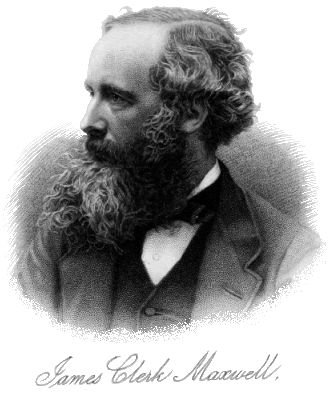
April 2009 - A summary paper by F.D. Tombe: "I've written
a new paper which summarizes the most important things in all the previous
papers since 15th February 2006. I have used the same title as
the first paper in the series because I now intend this paper to
be my main paper".
Abstract.
A particle that is undergoing absolute
transverse motion relative to any point in space will experience
a radial centrifugal force of repulsion relative to that point.
This centrifugal force will obey an inverse cube law in the radial
distance relative to the point. Space therefore possesses all the
hallmarks of a dipole field. If we equate Maxwell's molecular vortices
with rotating electron-positron dipoles, it follows that their rotation
axes will trace out the solenoidal magnetic lines of force, and
that the ensuing double helix alignment will account for the tension
that pulls unlike magnetic poles together. Centrifugal pressure will
account for the repulsion which exists laterally between magnetic lines
of force, and which pushes like magnetic poles apart.
New revised version: 22nd November 2009
Abstract.
In 1856, Weber and Kohlrausch performed an experiment
with a Leyden jar which showed that the ratio of the quantity of electricity
when measured statically, to the same quantity of electricity when
measured electrodynamically, is numerically equal to the directly
measured speed of light. In 1861, in his paper entitled "On Physical
Lines of Force", James Clerk-Maxwell equated the above ratio with the
ratio of the dielectric constant to the magnetic permeability. In the
same paper, Maxwell modelled Faraday's magnetic lines of force using
a sea of molecular vortices that were composed partly of aether and
partly of ordinary matter. He linked the dielectric constant to the transverse
elasticity of this vortex sea, and he linked the magnetic permeability
to the density.
Since Newton's equation for the speed of sound involves the
ratio of the transverse elasticity to the density, Maxwell was able
to insert the 1856 Weber/Kohlrausch ratio into this equation and show
that light is a wave in the same medium that is the cause of electric
and magnetic phenomena. It will now be suggested that Maxwell's molecular
vortices are more accurately represented by rotating electron-positron
dipoles that are aligned in a double helix fashion with their mutual
rotation axes tracing out the magnetic lines of force.
Abstract.
Maxwell's 1861 paper "On Physical Lines of Force"
(parts I to III)* is interpreted, and an improvement
is proposed which involves replacing his vortex
cells with rotating electron-positron dipoles.
The cause of magnetism is then explained in terms of a
vortex sea of electron-positron dipoles, in which
magnetic field lines are comprised of helical springs
created out these dipoles. The electron-positron dipoles
are bonded together in a double helix pattern and the resulting
helical springs close on themselves in elliptical or circular
solenoidal hoops.
Equation 77 in Maxwell's 1861 paper, is the Lorentz force...
* James Clerk-Maxwell published his paper "On Physical
Lines of Force" in 1861 in the Philosophical
Magazine:
http://vacuum-physics.com/Maxwell/maxwell_oplf.pdf
First version in this Forum: 1st April 2006 -
Second extended version: 10th
April 2006
New revised version: 25th June 2007:
Michelson-Morley and the Entrained Electric Sea
New revised version: 21th February 2008
Abstract.
Maxwell's 1861 paper "On Physical Lines of Force" is
interpreted. An improvement is proposed that involves replacing
his molecular vortices with rotating electron-positron
dipoles. These dipoles will each comprise
of an electron and a positron undergoing a
mutual orbit. Electromagnetism is then explained in
terms of an electric sea in which magnetic lines of force
are physically comprised of helical springs created out
of rotating electron-positron dipoles. The electron-positron
dipoles are bonded together in a double helix pattern
and the resulting helical springs form elliptical or circular
solenoidal hoops around an electric current circuit
or a bar magnet.
New revised version: 18th July 2008
New revised version: 28th December 2008
New revised version: 18th March 2009 ("I
made some references in the Michelson-Morley
section to the extent that the gravitosphere may actually
go up higher than the magnetosphere ")
New revised version: 5th March 2009
* * * * *
Many other papers of F.D. Tombe are available, together with
their presentation, in the following web page:
Here it is anyway their complete list:
B - Gravitation, Electrostatics,
and the Electron-Positron Aether (Ether)
(Based on the 1982 paper by David Tombe, entitled
"Electrogravitomagnetism")
22nd August 2008: This paper has been
totally withdrawn
(together with paper I)
, for the reason that it centres
around a theory which attempts to rationalize
inertial mass as being related to the sum of the
"modulus" of the electric charge in a body. More recently,
I have been working on a different principle as
explained in the paper at N2 entitled "Negative Mass and the
Gravity Sink".
The ideas contained in this paper
concerning inertial mass were only peripheral to
the main theme regarding an electron-positron luminiferous
medium. These ideas concerning inertial mass have
now been superseded by a new theory which involves absolute
values as opposed to 'modulus' values of charge
.
(We maintain nevertheless a copy of the paper
for history's sake.)
E - Gravity Reversal and Atomic
Bonding
(A Theory of Mutually Attracting Sinks)
[Note of the Editor: As far as the following
assertion is concerne d:
«
the Earth's magnetic field
is explained by virtue of the fact that
the Earth is a rotating negatively charged object»
, the reader could be
interested even in the paper presented in
next point 8.]
(The Epicycle Theory of the Atom)
(New revised version: 5th August 2008)
I - Charge, Spin, and 'Charge
to Mass' Ratio
(A Unified Theory of Gravity and Electricity)
22nd August 2008: This paper has been
totally withdrawn
(together with paper B)
, for the reason that
it centres around a theory which attempts to rationalize
inertial mass as being related to the sum of the "modulus"
of the electric charge in a body. More recently, I
have been working on a different principle as explained
in the paper at N2 entitled "Negative Mass and the Gravity
Sink".
The ideas contained in this paper
concerning inertial mass were only peripheral
to the main theme regarding an electron-positron luminiferous
medium. These ideas concerning inertial mass have
now been superseded by a new theory which involves absolute
values as opposed to 'modulus' values of charge,
and the theories concerning centrifugal force and
Coriolis force contained within this paper have been expanded
upon in the paper at Q2 entitled "The Cause of Centrifugal
Force"
.
(We maintain nevertheless a copy of the paper
for history's sake.)
(New revised version: 5th August 2008)
L -
The Aether and the Electric Sea
(The Link between Gravity and Electromagnetism)
(New revised version: 18th February 2009)
(
New revised version: 5th March 2009)
New revised version: 18th March 2009
("The amendment changed a paragraph
in the section about inertia")
(New revised version of L: 2nd June 2009
"Another section mentioning inertia was removed". We maintain
nevertheless a copy of the previous paper for history's sake.)
(New revised version of U': 2nd June 2009
"This was a major amendment based on the realization that
the Coriolis force is a real transverse force that arises in connection
with the conservation of angular momentum". We maintain nevertheless
a copy of the previous paper for history's sake.)
Y -
The Four Kinds of Electric Charge
(A vitreous electricity explanation for infinite supplies
of electric charge)
(New revised version: 24th September 2008)
(New revised version: 14th December 2008)
(New revised version: 2nd June 2009
"A general re-wording without any major change in the content".)
A2' - Bernoulli's Principle and the
Theory of Flight
(New revised version of A2: 2nd June 2009
"This was a major re-write with an increased emphasis on the
role of the centrifugal force in the air molecules". We maintain
nevertheless a copy of the previous paper for history's sake.)
(New revised version: 18th May 2008)
(New revised version: 18th February 2009)
N2 - Negative Mass and the Gravity Sink
O2 - The General Convective Force
(A General Survey of the Coriolis force and the Centrifugal
force)
(New revised version: 9th June 2008)
(New revised version: 19th August 2008
)
P2 -
Centrifugal Force in the Electric Circuit
(New revised version: 28th December 2008:
"The focus was in amending the section on EM induction
in relation to Coriolis Force", see T2 and T2')
(New revised version: 29th January 2009)
New revised version: 18th March 2009 ("The
wording in the centrifugal force section was improved to emphasize
the extrapolation of the general principle of centrifugal
force to the four body problem in which two closed orbital systems
sit side by side, and therefore must repel each other
")
P2' -
Centrifugal Force in the Electric Circuit
(New revised version of P2: 2nd June 2009
"This revision goes into much more detail
on the role of the Coriolis force in the induction of current
in a wire that is moving through a magnetic field". We maintain
nevertheless a copy of the previous paper for history's sake.)
(New revised version: 19th August 2008)
(New revised version: 7th December 2008 )
(New revised version: 5th March 2009)
Q2' - The Cause of Centrifugal Force
(New revised version of Q2: 2nd June 2009
"This was a major re-write based on the realization that the
inverse cube law points to a dipole field". We maintain nevertheless
a copy of the previous paper for history's sake.)
(New revised version: 28th August 2008)
(New revised version: 14th December 2008)
S2 - The Coriolis Force and the Screw
T2 -
Areal Velocity, Coriolis Force, and Vorticity
T2' -
The Cause of Coriolis
Force
(New revised version of T2: 28th December 2008)
"T2' is a major amendment. I've taken all the contents into what
is effectively a new paper". We maintain nevertheless a copy of
the previous paper for history's sake.
(New revised version: 5th March
2009)
T2'' -
The Cause of Coriolis Force
(New revised version of T2': 2nd June 2009)
"This was a major re-write based on a clearer division
between transverse Coriolis force and axial Coriolis force"
. We maintain nevertheless a copy of the previous
paper for history's sake.
U2 -
Displacement Current
(New revised version: 14th December 2008)
V2 - Displacement Current 2
(New revised version: 18th February 2009)
Y2 - Wave/Particle
Duality in Electromagnetic Radiation
Z2 -
Wave/Particle
Duality in Cathode Rays
A3 -
Cathode Rays,
Gravity, and Electromagnetic Radiation
(New revised version: 14th December 2008)
B3 -
Tangential Force
– The Equilibrium Shifter
(New revised version: 29th January 2009)
New revised version: 18th March 2009 ("Appendix
B was removed as it was a bit hard to read, and out of context,
and it will be the subject of a separate paper some time in
the future ")
B3' -
Lenz's Law
(New revised version of B3: 5th November 2009
This is a major re-write of the previous paper,
we maintain nevertheless a copy of the older one for history's sake.)
C3 - The Key that Winds up the Universe
New revised version: 18th March 2009 ("Large,
somewhat confusing sections on 'inertia' were removed. A new
paper on inertia will be written some time in the future")
D3 -
Electromagnetism and the Rolling
Wheel
E3 - The Superimposition of
Radiation and Gravity
New revised version: 5th March 2009
F3 - The Rotationally Elastic
Sponge
G3 - Kepler's Law of Areal Velocity
in Cyclones
H3 -
Inertia and the Electric Sea
I3 -
The Coriolis Force is a System of Accountancy for Real Forces
J3 -
The Physical Nature of the Coriolis Force
Un nuovo lavoro, febbraio 2010 - A new paper, February 2010:
K3 - Maxwell's Sea of Molecular Vortices
_____________________________________________________________
5 - Aldo Spranzi
Una presentazione di:
Il segreto di Alessandro Manzoni
Che cosa nasconde l'autore dei
Promessi sposi?
(versione pdf)
Una manzoniana detective story
Ed. Unicopli, Milano, 2001
Dopo la lettura trasgressiva del romanzo
manzoniano proposta nel 1995 (
Anticritica dei Promessi
sposi , EGEA, Milano)
- dalla quale emerge lo sconcertante
fraintendimento del capolavoro nazionale
da parte della nostra cultura,
e risaltano la genialità e la sconvolgente
attualità del romanzo manzoniano
mortificate dall'interpretazione tradizionale
- Aldo Spranzi presenta ora una rivisitazione
della biografia manzoniana dalla
quale esce un Alessandro Manzoni irriconoscibile.
La tesi sostenuta è che
Manzoni abbia finto per tutta la
vita una fede che non aveva per coprire
la finzione che domina il romanzo, apparentemente
apologia della religione cattolica,
di fatto opera pervasa da un radicale
nichilismo anticristiano.
I sospetti di insincerità
religiosa del Manzoni sono sempre
esistiti, ed è noto l'atteggiamento
di estremo sospetto che serpeggiava nel
secolo scorso nel mondo cattolico. Ciò
che ha impedito a questi sospetti di avere un
esito e mettere in discussione il mito del Manzoni
cattolico è stata l'imperscrutabilità
del movente: perché Manzoni
avrebbe mentito per tutta la vita?
Ne
Il segreto
di Alessandro Manzoni
Aldo Spranzi svela il movente e scopre
le modalità tecniche dell'impostura
manzoniana. La rivalutazione
del romanzo e della biografia consentono un incontro
inedito, stupefacente ed entusiasmante con
una delle massime espressioni del genio. Anche
l'uomo, non solo l'artista, grandeggia:
scompare il Manzoni untuoso, scostante, bigotto,
imposto dalla sua impostura, e ci troviamo di
fronte a una sorta di superuomo, protagonista di un'incredibile,
affascinante avventura esistenziale.
Aldo Spranzi è
Professore ordinario nella Facoltà
di Scienze politiche dell'Università
di Milano, dove insegna Economia
dell'arte, e direttore del Cescom dell'Università
Bocconi.
È coordinatore nazionale di una ricerca interdisciplinare
finanziata dal Ministero
dell'Università e della
Ricerca scientifica su "Il consumo
di arte: l'industria culturale e la
diffusione dell'arte. Il caso del romanzo".
____________________________________________________
6 - Allen Esterson
[We propose with pleasure to the readers of our Forum the information
contained in the following letter, grateful
to its author.]
<< I refer to the anonymous article "Mileva Einstein-Maric"
published on the
"Episteme" website at:
http://itis.volta.alessandria.it/episteme/ep4/ep4maric.htm
You may
not be aware that all the claims made
on behalf of Mileva Maric's contributing
to Einstein's 1905 papers have been
refuted by knowledgeable physicists involved
with the Einstein Archive, such as Gerald
Holton and John Stachel (founding
editor of the Albert Einstein Collected Papers project).
More specifically, I have examined all the claims in
detail, including those made Senta Troemel-Ploetz,
Evan Harris Walker and
Desanka Trbuhovic-Gjuric cited
by the anonymous author on your website,
and found that they are based on erroneous
assumptions and misconceptions. I
invite you to read my detailed critique of
these claims, posted on my website at:
____________________________________________________
7 - G.O. Mueller and Karl Kneckebrodt
Description of a German Research Project of international
scope, presenting a documentation of 3789
publications criticizing
the theory, distributing this
documentation to libraries, to
the printed media and to eminent representatives
of public opinion...
Other links:
http://www.cartesio-episteme.net/fis/mueller.htm
http://www.wbabin.net/science/mueller.pdf
http://www.ekkehard-friebe.de/partner.html
____________________________________________________
8 - Stefan Marinov (in memoriam )
In paper F of Section N. 4 (F.D. Tombe, "Gravity
is Negative Electricity"), one finds
the assertion: <<the Earth's
magnetic field is explained by virtue of the
fact that the Earth is a rotating negatively
charged object>>. Thus we thought
useful to insert a reference to footnote N.
40 in
http://www.cartesio-episteme.net/falsper.html
:
<<40 - Non bisognerebbe dimenticare a questo proposito
che l’effetto della rotazione diurna
della terra sulla velocità
della luce è stato già
rilevato con successo dallo stesso
A.A. Michelson del celebre esperimento,
in collaborazione con H.G Gale, e prima di
loro ancora da G. Sagnac. "Sfortunatamente",
la teoria della relatività appare perfettattamente
in grado di spiegare gli stessi risultati
(cfr. per esempio: E. Borel,
Space and Time
, Dover Pub., New York, 1960,
p. 190; per un parere contrario, invece:
R. Monti, "The Michelson-Morley, Sagnac and Michelson-Gale
Experiments",
Atti del IX Congresso Internazionale di Storia
della Fisica
, Overseas, Milano, 1988). L'ipotesi in questione
è stata recentemente ridiscussa
da H.C. Hayden ("Experimentum Crucis",
Galilean Electrodynamics
, 1, 1, 1989), il quale argomenta
come i risultati del famoso esperimento
elettromagnetico di Trouton-Noble potrebbero
essere compatibili con una velocità
assoluta del laboratorio terrestre di circa 300 m/sec,
cento volte inferiore ai 30 km/sec che si stava
cercando, invano, di mettere in evidenza. E' interessante
notare che in effetti al termine del lavoro illustrante
un altro celebre esperimento, considerato "a favore
della teoria della relatività" ("Experimental
Establishment of the Relativity of Time", R.J.
Kennedy & E.M. Thorndike,
Phys. Review ,
42, 1932) si riconosca l’esistenza di una (piccola)
fluttuazione avente un periodo di 24 ore. Inoltre,
conformemente al principio che un campo magnetico è
generato da una carica elettrica in movimento nell'etere,
questa ipotesi sembra essere capace di spiegare anche l'origine
del campo magnetico terrestre, come effetto della detta
velocità di rotazione diurna del pianeta Terra,
e del suo ben noto possesso di una carica elettrica negativa
(vedi per esempio: U. Bartocci, "On a possible experimental
discrimination between classical and relativistic
electrodynamics", Atti
del Convegno Internazionale "Quale fisica per il 2000?"
, Ischia, 1991, Ed. Andromeda,
Bologna, 1992; S. Marinov, "A new hypothesis for
the origin of Earth's magnetism",
Deutsche Physik
, 2, 5, 1993; "Earth's rotation
is the cause for its magnetization",
Il Nuovo Cimento
, Vol. 19 C, N. 2, 1996).>>
and then, since Deutsche Physik
is a journal which is difficult to
find in scientific libraries, to
publish the images of the pages of the
first of the two quoted paper by our friend
Stefan Marinov, in his constant memory.
______________________________________________________________
9 - ANNUNCIO DI SCOPERTA SCIENTIFICA
IL TUONO NUCLEARE: NEUTRONI DAGLI ULTRASUONI
(Una foto dell'équipe guidata dal Prof. Fabio Cardone)
Due fisici italiani, Fabio Cardone e Roberto Mignani,
hanno annunciato la realizzazione di reazioni nucleari
prodotte con gli ultrasuoni.
La scoperta, che si inserisce nel filone della cosiddette
"reazioni
nucleari ultrasoniche", è stata
descritta in un volume intitolato
Deformed Spacetime , che è
in corso di pubblicazione (I trimestre 2007)
presso la prestigiosa casa editrice tedesca
Springer Verlag di Berlino.
In quest'opera i due fisici affermano di aver generato
neutroni immettendo ultrasuoni in varie
soluzioni di acqua ed acidi
di ferro. I neutroni sono stati misurati
con rivelatori termodinamici in uso
per sistemi di difesa ottenendo il 100%
della ripetibilità dell'esperimento.
Il fenomeno scoperto ispira facilmente
la concezione di un reattore ad ultrasuoni
, i cui vantaggi nella produzione
di "energia pulita" sono più che evidenti.
Gli esperimenti diretti da F. Cardone sono stati condotti
in Italia a partire dal
2003 presso laboratori militari e
civili con la collaborazione dei tecnici
militari A. Aracu, A. Bellitto, F. Contalbo,
P. Muraglia e dei ricercatori civili
G. Cherubini, A. Petrucci, F. Rosetto, G. Spera.
Tale scoperta, insieme ad altre sulla gravità
e l'elettricità presentate nel volume menzionato,
permetterà
di ripensare in modo critico le teorie
della relatività di Einstein
e della meccanica quantistica di Bohr.
Perugia, Novembre 2006, da Umberto Bartocci
(Il Prof. Fabio Cardone)
Annoucing a Scientific Discovery
Nuclear Thunder: Neutrons from Ultrasound
Two Italian physicists, Fabio Cardone and Roberto
Mignani, have announced that they obtained
nuclear products using ultrasound.
The discovery, which is part of ongoing work on so-called
"ultrasonic nuclear reactions", has been described
in a publication titled Deformed Spacetime
, which is to be published by the German
Springer publishing house in Berlin.
In this work, the two physicists claim they have generated
neutrons irradiating
various solutions of water and ferrous
acids with ultrasound. The neutrons were
measured with thermodynamic sensors used
in defense related research, with 100 % repeatability
of the experiment. The discovery inspires
visions of an ultrasonic reactor for the production
of "clean energy", a new concept with obvious
advantages.
The experiments directed by Fabio Cardone were done
in Italy starting in 2003 in both civil and military
laboratories and with the collaboration
of military technicians Aracu,
Bellitto, Contalbo and Muraglia as well as
civilian researchers Cherubini, Petrucci,
Rosetto and Spera.
The discovery, says Prof. Umberto Bartocci of Perugia,
Italy, together with other works about gravitation
and electricity presented
in the same publication, will lead
to a critical re-evaluation of Einstein's
theory of relativity and Bohr's quantum mechanics.
Translation by courtesy of Josef Hasslberger
http://www.hasslberger.com/
- - - - -
10 novembre 2007
Siamo lieti
di constatare che, grazie all'iniziativa
di un giornalista coraggioso (il noto
Antonio Socci), si è aperto uno spiraglio
informativo sulle notizie di cui sopra. Presumibilmente
adesso l'establishment sarà
costretto a pronunciarsi, vuoi
PROVANDO che si tratta di una "bufala" (come
continuano a sostenere dei fisici in alcuni mail che
ho recentemente ricevuto), vuoi CONFERMANDO il risultato,
con tutte le conseguenze che Socci ha chiaramente
illustrato sulle pagine di Libero
lo scorso 2 novembre...
Poiché non siamo riusciti a reperire
l'ampio servizio in rete, pensiamo di fare cosa utile
ai lettori, e di non violare nessuna "regola"
, proponendone qui di seguito una scansione
(ogni pagina è suddivisa giocoforza
in due immagini; se ne aumentino in caso le
dimensioni per poter leggere meglio il testo).
articolo, pagina 1, prima metà
articolo, pagina 1, seconda metà
articolo, pagina 2, prima metà
articolo, pagina 2, seconda
metà
articolo, pagina 3, prima
metà
articolo, pagina 3, seconda
metà
- - - - -
24 maggio 2008 (dopo la conclusione
della VI Conferenza
sulle Nuove Energie, tenutasi a Grottammare, con
un intervento del Prof. Cardone)
, link al sito dell'O.N.N.E (Organizzazione
Nazionale Nuove Energie), dove sono già disponibili
gli Atti del Convegno:
Ulteriori informazioni sulle ricerche del Prof. Fabio Cardone
si possono trovare nel seguente sito:
In esso si può pure scaricare una copia del libro
del Prof. Cardone:
VERSO IL NUCLEARE PULITO.
Vedi anche:
_______________________________________________________________________________
10 - MASTER “ENRICO MATTEI IN MEDIO ORIENTE”
EDIZIONE 2006-2007 (Università
degli Studi di Teramo)
COMUNICATO STAMPA
Due le novità principali per
la seconda edizione del master: l'introduzione
di un corso di lingua araba, della
durata di 120 ore, e la possibilità
di conseguire un titolo sia di primo che
di secondo livello, grazie ad una didattica
articolata in due corsi analoghi nei contenuti,
ma differenziati per alcuni aspetti fra cui
le attività seminariali e le prove di
verifica. Il master, a cui partecipano anche molti
docenti dell'Ateneo teramano, affiancherà
ai corsi seminariali conferenze e tavole
rotonde con esperti esterni. Il corso seguirà
un metodo multidisciplinare e punta alla
formazione di esperti destinati ad operare in
un’area geografica cruciale dei nostri tempi.
La formazione professionale riguarda esperti per imprese
private italiane con interessi commerciali nei paesi
mediorientali; esperti destinati all’attività
politico- diplomatica; cooperanti e organizzazioni
non governative impegnati in operazioni di peace-keeping;
giornalisti e corrispondenti dalla regione; esperti
in immigrazione e interculturalità
e nel turismo. Le domande di partecipazione sono aperte
fino all’ 11 dicembre 2006. (I COLLOQUI MOTIVAZIONALI
PER L’AMMISSIONE VENERDI’ 16 NOVEMBRE).
PRIMA LISTA DEI DOCENTI DELL'EDIZIONE 2006-2007
(CUI SE NE AGGIUNGERANNO MOLTI ALTRI)
ENNIO DI NOLFO (relazioni internazionali), ROBERTO MORRIONE
(mass media), ADOLFO PEPE (geopolitica), AUGUSTO SINAGRA
(diritto internazionali),
ROBERTO ALIBONI (relazioni internazionali,
Iai) , MAURO MELLINI (avvocato),
SAMIR AL QARYOUTI (mass media), MAURIZIO
BLONDET (geopolitica), PAOLO BARGIACCHI (diritto
internazionale), BRUNA BAGNATO (politica
euromediterranea) , GIORGIO GALLI (enrico
mattei), BENITO LIVIGNI (enrico mattei), UGO TRAMBALLI
(mass media), FABIO ALBERTI (un ponte per) ,
SALVATORE BONO (islam), MAURIZIO DONATO (economia),
CLAUDIO MOFFA (geopolitica), PASQUALE IUSO (storia
contemporanea)
Per info: 320/0892770 - 389/9960722 -
www.mastermatteimedioriente.it
c.moffa@gawab.com
____________________________________________________________________________
11 - Accogliamo con grande piacere il ritorno di un autore
ben noto ai lettori di Episteme .
L'Ing.
Lino Lista ci presente un suo appassionato:
Prossimamente,
un'analisi della Pudicizia, "un marmo
filosofale" della Cappella San Severo
a Napoli.
- - - - -
10 novembre 2007
Siamo lieti di poter finalmente dare seguito all'annuncio di
cui sopra.
Ringraziamo
l'autore anche a nome di tutti i lettori
di Episteme per un'attenzione
che ci onora.
- - - - -
20 febbraio 2010
In occasione del terzo centenario della nascita di Raimondo di Sangro, settimo
Principe di Sansevero (Torremaggiore, 30 gennaio 1710 - Napoli,
22 marzo 1771), siamo lieti di presentare una sua commemorazione
scritta dall'Ing. Lino Lista.
____________________________________________________________________________
12 - La casa editrice Il Cerchio invia cortesemente alla
(purtroppo ormai defunta!) redazione di
Episteme
il seguente interessante libro, che ci
piace allora presentare nelle pagine
del Forum.
(Pur con qualche ovvia riserva, dato il punto di vista
di Episteme: non
ci sembra proprio per esempio che la
"rivoluzione quantistica" sia ignorata
dal paradigma dominante, anzi. Di essa si potrebbe
fare benissimo a meno, sull'auspicata
strada di un rinnovamento scientifico-filosofico,
semplicemente riconsiderando il "vecchio" dualismo
cartesiano...)

Dalla critica al darwinismo agli albori di
una
scienza nuova
Esattamente 10 anni fa, il giornalista
scientifico John Horgan,
a lungo redattore presso "Scientific
American", pubblicava un saggio,
The End of Science
(Trad. it.
La fine della scienza
, Milano 1998) che fece scalpore per
il suo provocatorio annuncio di un'imminente
"fine della scienza", intendendo con questo
l'apparente impossibilità, per lo
ricerca moderna, di indagare ancora oltre i limiti
già raggiunti.
Secondo Horgan, infatti,
la ricerca scientifica sarebbe oggi ad un punto
di non ritorno, oltre il quale i tradizionali sistemi
d'indagine non avrebbero più
alcuna utilità: sarebbero incapaci,
cioè, di aprire lo strada verso quella
che è, in fin dei conti, lo vera Meta verso
lo quale ogni ricercatore in cuor suo tende,
quella che Horgan chiama
La Risposta , il
modello teorico capace di offrire una chiave di
lettura organica e soddisfacente del reale.
Secondo questa pessimistica
profezia, dunque, lo scienza del prossimo
futuro si troverebbe costretta alla
resa di fronte all'insuperabile muro
dell'ignoto: destinata ad accontentarsi
delle soluzioni trovate - lì dove
esse sono state realmente trovate - condannata
a brancolare nel buio delle mere ipotesi o, peggio
ancora, ad essere ridotta al frustrante e pericoloso
rango di ancilla tecnologiae
, meramente asservita
agli interessi per nulla speculativi e spesso
inquietanti dell'industria e del
business
economico.
Oggi tuttavia, a diec'anni
da quel provocatorio annuncio, molti si chiedono
se la tanto temuta fine
della scienza
non possa considerarsi,
piuttosto, come il travagliato avvio della
nascita di una scienza nuova, tramite l'avvento
di un diverso paradigma e di una differente chiave
di lettura della realtà.
Certo, i segni di stasi
e di involuzione che già spinsero Horgan
a lanciare il suo clamoroso annuncio sono
a tuttora ben visibili: mai come oggi,
anzi, una parte ancora maggioritaria del mondo
accademico sembra pigramente attardarsi
su posizioni datate, protetta solo dalla consolante
ma sterile barriera del conformismo.
Al tempo stesso, però,
molti segni ci parlano di un cambiamento
in atto, lento ma straordinariamente
profondo, che vede l'ingresso a pieno
titolo, nell'ambito scientifico, di paradigmi
fino a ieri considerati
eretici
, ma che in un futuro prossimo potrebbero
semplicemente rivelarsi come rivoluzionari.
Durante il XX secolo, ad
esempio, si è assistito - con sorpresa
e persino sgomento da parte di taluni - al passaggio
dalla fisica c1assica, rigidamente
meccanicista, agli orizzonti straordinariamente
ampi della fisica quantistica, che coi
suoi paradossi ha messo in crisi i concetti stessi
di materia e di causa/effetto. Una rivoluzione
questa solo a fatica addomesticata
-
e in qualche caso semplicemente ignorata -
dall' establishment
accademico.
Al tempo stesso, sul piano
delle cosiddette "scienze umane", il
vecchio materialismo
ad una dimensione
di cui fu paladino e corifeo
un Freud, ha dovuto cedere pian piano il
passo, causa inadeguatezza, alle più
ampie prospettive di un Jung, di un Hillmann
o di un Frankl: prospettive che presuppongono,
a loro volta, una visione dell'uomo e dello stesso
cosmo infinitamente più complessa e profonda.
Bisogna avere il coraggio
di domandarsi, dunque, se questa tanto temuta
fine della scienza
non sia nient'altro, infondo,
che la fine di un tipo
di scienza, identificabile
essenzialmente con quel paradigma materialista/meccanicista
che è figlio della filosofia
dell'Ottocento. Un paradigma, questo, che
si dimostra ogni giorno sempre più limitato
e incapace di offrire risposte soddisfacenti
alle domande che la stessa scienza moderna tende vieppiù
a riscoprire.
Ed è in quest'ottica
di superamento che va letto il grande fenomeno
oggi sempre più alla ribalta nonostante
gli ostruzionismi dell'ortodossia accademica
- della critica all'ipotesi
neo-darwinista
, ossia all'ultimo,
grande dogma del materialismo classico.
In effetti, la cosiddetta
teoria sintetica dell'evoluzione
ha rappresentato per
decenni una vera e propria colonna portante
della Weltanschauung
materialistico-meccanicista:
il tentativo più completo
e certamente ambizioso di ridurre la sorprendente
ricchezza e sconcertante complessità
della materia vivente a mero riflesso del
Caso e della Necessità.
Per quasi un secolo, infatti,
il neodarwinismo ha diffuso
universalmente una visione paradossale
della Natura vivente, dove ogni realtà
o qualità, dalla grazia di una piuma
alla potenza di un muscolo, dalla perfezione
tecnica di un organo oculare all'astronomica complessità
del cervello umano, non sarebbero
altro che il frutto di meri
errori
di trascrizione del DNA (le cosiddette mutazioni
casuali), addomesticate dal potere ritenuto onnipotente
della convenienza e dell'adattabilità
(la cosiddetta selezione naturale).
Questa visione totalizzante
e monolitica, potentemente sostenuta dal
clima filosofico dominante ancor prima
che da intrinseche prove scientifiche,
è però fatalmente entrata in
crisi parallelamente alla crescita delle
conoscenze sulla natura vivente. sulla genetica,
sui fossili. Il modello neodarwinista, infatti,
non sembra capace di dare risposta alcuna all'irriducibile
complessità delle forme viventi, al
ruolo che appare più conservativo che
"creativo" della selezione naturale, alla mancanza
di documenti fossili che dimostrino l'andamento "lento
e progressivo" dell'evoluzione, al grande
enigma dell'apparizione della vita sulla Terra.
Anche il neodarwinismo,
dunque, al pari di altre visioni e ipotesi
scaturite dal meccanicismo ottocentesco,
ha dovuto arrendersi di fronte ad una
realtà che appare, ogni giorno di
più, totalmente altra
rispetto ad ogni riduzionismo.
Da questo punto di vista, la critica al neodarwinismo
- finalmente redenta dalla sterile contrapposizione
tra "mastini" di Darwin e improponibili
fondamentalismi pseudoreligiosi - rappresenta
la vera avanguardia di un nuovo modo di intendere
la natura e la scienza, in una chiave di lettura
organica e olistica, in cui la teoria dell'evoluzione,
liberatasi da ogni forma di "evoluzionismo"
ideologico, si sposa alle più recenti prospettive
emerse dalla scienza moderna, su tutte la fisica quantistica.
Con questo numero speciale
"Avallon" ha voluto, per la prima volta
in Italia, presentare un'antologia di contributi,
unica per varietà e qualità,
delle più interessanti correnti del
post-darwinismo, da cui emerge una visione
della natura affascinante e straordinariamente
ricca. Un'antologia che, all'inevitabile
pars destruens
rappresentata dalla critica al
vecchio paradigma, fa seguire la necessaria
pars construens
rappresentata da un significativo
excursus
attraverso i nuovi paradigmi proposti.
Il Cerchio Iniziative Editoriali
Via Dell'Allodola, 8 -
47900 Rimini
ilcerchio@iper.net
,
http://www.ilcerchio.it
____________________________________________________________________________
13 -ETHER SPACE-TIME AND COSMOLOGY
(April 2008)

ETHER SPACE-TIME & COSMOLOGY
(The present document indicates the contents and order processing
of volume 1,
and the instructions to contributors
to future volumes).
VOLUME 1
Copyright © 2008 by PD Publications, Liverpool, UK
All rights reserved
No parts of this book may be reproduced stored in a retrieval
system
and transmitted in any form or by any means
without the written permission of the copyright owner.
Ether space-time and cosmology
Volume 1: Modern ether concepts relativity and geometry
Michael C. Duffy and Joseph Levy Editors
Volodymyr Krasnoholovets Executive editor
ISBN: 1 873 694 10 5
438 pages, Size 252/180mm
Illustration, front: Helix nebula by Robert Gendler
http://www.robgendlerastropics.com
Printed and bound in England by CPI Antony Rowe Ltd, Wiltshire
A book dealing with experimental and theoretical studies
devoted to the exploration of the modern ether concept, evidence
of its reality and implications for modern physics.
Contents of Volume one
-5- Editor’s
Foreword
-7- Introduction
-13- Ether
as a Disclosing Model
Michael C. Duffy, School of Computing & Technology, University
of Sunderland, Sunderland,
Great Britain, SR1 3SD, & PO Box 342,
Burnley, Lancashire, GB, BB10 1XL. E-mail: michael.duffy9@btopenworld.com
-47- Einstein’s
New Ether 1916-1955
Ludwik Kostro, Department for Logic, Methodology and Philosophy
of Science, University of Gdańsk, ul. Bielańska 5,
80-851 Gdańsk, Poland, E-mail:
fizlk@univ.gda.pl
-69- Basic
Concepts for a Fundamental Aether Theory
Joseph Levy, 4 square Anatole France, 91250 St Germain-lès-Corbeil,
France, E-mail: levy.joseph@orange.fr
-125- Aether
Theory and the Principle of Relativity
Joseph Levy, 4 square Anatole France, 91250 St Germain-lès-Corbeil,
France E-mail: levy.joseph@orange.fr
-139- Ether
Theory of Gravitation, Why and How
Mayeul Arminjon, Laboratoire Sols, Solides, Structures, Risques,
CNRS & Université de Grenoble,
BP 53, F-38041, Grenoble Cedex 9 France.
-203- A Dust
Universe Solution to the Dark Energy Problem
James G. Gilson, School of Mathematical Sciences, Queen Mary
University of London, Mile End Road, London E14NS, United
Kingdom, E-mail: j.g.gilson@qmul.ac.uk
-217- Eddington
Ether and Number
Raul A. Simon, LAMB, Santiago, Chile
-257- The
dynamical Space-time as a Field Configuration
in a Background Space-time
A.N. Petrov, Department of Physics and Astronomy, University
of Missouri,-Columbia, Columbia MO 65211, USA and Sternberg
Astronomical Institute, Universitetskii
pr., 13 Moskow 119992 Russia, E-mail: anpetrov@rol.ru
-305- Locality
and Electromagnetic Momentum in Critical
Tests of Special Relativity
Gianfranco Spavieri, Jesus Quintero, Arturo Sanchez, José
Ayazo, Centro de Fisica Fundamental, Universidad
de los Andes, Merida 5101-Venezuela,
E-mail : Spavieri@ula.ve
And Georges T. Gillies Department of Mechanical and Aerospace
Engineering, University of Virginia, P.O. Box 400746, Charlottesville,
Virginia 22904, USA, E-mail:
gtg@Virginia.edu
-357- Correlations
Leading to Space-time Structure in an
Ether
J.E. Carroll,
Engineering Department, University
of Cambridge, CB2 1PZ, United Kingdom, E.mail: jec1000@cam.ac.u
-407- Reasons
for Gravitational Mass and the Problem
of Quantum Gravity
V. Krasnoholovets,
Institute for basic research,
90 East Winds Court, Palm Harbor, Fl 34683, USA
ABSTRACTS
ETHER AS A DISCLOSING MODEL
M. C. Duffy, School of Computing & Technology, University
of Sunderland, Sunderland, Great Britain, SR1 3SD, & PO
Box 342, Burnley, Lancashire, GB, BB10 1XL.
michael.duffy9@btopenworld.com
ABSTRACT
The modern ether concept is compatible with relativity, quantum
mechanics, and non-classical geometrization.
Misuse of the term "ether" in anti-Relativity
polemics in former times causes many physicists
to avoid the word and equivalent terms are used
instead. The modern concept results from three
development programmes. First, there was the evolution
of Relativity, Relativistic Cosmology and Geometrodynamics
which discarded the early 20th C passive, rigid, ether
in favour of geometrized space-time. A non-classical
ether, defined as field or space-time, was accepted by Einstein
in his later years. This had two main aspects: static (or
geometric) and dynamic (or frame-space perspective). Second,
there was a Lorentzian programme, which provided a quasi-classical
exposition of Relativity in terms of moving rod and clock
readings. The Einstein-Minkowski and the Lorentzian programmes
can be reconciled. The third development programme
is associated with Quantum Mechanics and studies of the
physical vacuum. A group of analogues based on the
vortex sponge promises to unify these programmes of interpretation.
The modern ether, from the smallest scale point of view,
resembles a "sea of information", which demands new techniques
for interpreting it, drawn from information science,
computer science, and communications theory.
Key Words: Analogues; Ether; Relativity; Space-Time Geometry;
Physical Vacuum.
EINSTEIN'S NEW ETHER 1916 - 1955
Ludwik Kostro Department for Logic, Methodology and Philosophy
of Science, University of Gdańsk,
ul. Bielańska 5, 80-851 Gdańsk, Poland, E-mail: fizlk@univ.gda.pl
ABSTRACT
In 1905 A. Einstein banished the ether from physics in connection
with the formulation of his Special
Relativity Theory. This is very well
known but less known is the fact that in 1916 he
reintroduced the ether in connection with his General
Relativity. He denominated it “new ether”
because, in opposition to the old one, the new one
did not violate his Special and General Principle
of Relativity. It didn’t violate it because the
new ether is not conceived as a privileged reference frame
but it is considered as an ultra-referential primordial
material reality which is not composed of points (or particles)
and not divisible in parts and to which therefore the
notions of motion and rest are not applicable. The purpose
of this paper is to present a short outline of the history
of Einstein’s concepts on ether and to show which
elements of the mathematical formalism of General Relativity
were considered by Einstein as mathematical tools describing
the relativistic ether, i.e. the ultra-referential space-time
characterized with a certain kind of energy density. It will
be indicated also that Einstein’s intuitions and
ideas concerning the ultra-referential space-time have
to be investigated in the framework of Connes’ non-commutative
geometry, as the commutative geometries are not sufficient
to do it. In Poland Michal Heller and his colleagues are trying
to create an unification of General Relativity and Quantum
Mechanics with the help of Connes’ non-commutative
geometry.
BASIC CONCEPTS FOR A FUNDAMENTAL AETHER THEORY
Joseph Levy
4 square Anatole France, 91250 St Germain-lès-Corbeil,
France ,
E-mail: levy.joseph@orange.fr
ABSTRACT
In the light of recent experimental and theoretical data, we
go back to the studies tackled in previous publications
[1] and develop some of their consequences.
Some of their main aspects will be studied
in further detail. Yet this text remains self-
sufficient. The questions asked following these
studies will be answered. The consistency of these developments
in addition to the experimental results, enable to
strongly support the existence of a preferred aether frame
and of the anisotropy of the one-way speed of light in the
Earth frame. The theory demonstrates that the apparent
invariance of the speed of light results from the systematic
measurement distortions entailed by length contraction,
clock retardation and the synchronization procedures with
light signals or by slow clock transport. Contrary to what
is often believed, these two methods have been demonstrated
to be equivalent by several authors [1]. The compatibility
of the relativity principle with the existence of a preferred
aether frame and with mass-energy conservation is discussed
and the relation existing between the aether and inertial
mass is investigated. The experimental space-time transformations
connect co-ordinates altered by the systematic measurement
distortions. Once these distortions are corrected,
the hidden variables they conceal are disclosed. The theory
sheds light on several points of physics which had not found a
satisfactory explanation before. (Further important comments
will be made in ref [1d]).
AETHER THEORY AND THE PRINCIPLE OF RELATIVITY
Joseph Levy
4 Square Anatole France, 91250 St Germain-lès-Corbeil,
France
E. Mail: levy.joseph@orange.fr
ABSTRACT
This paper completes and comments on some aspects of our previous
publications. In ref [1],
we have derived a set of space-time transformations
referred to as the extended space-time transformations.
These transformations, which assume the
existence of a preferred aether frame and the variability
of the one-way speed of light in the other frames,
are compared to the Lorentz-Poincaré transformations.
We demonstrate that the extended transformations
can be converted into a set of equations that have a similar
mathematical form to the Lorentz-Poincaré transformations,
but which differ from them in that they connect
reference frames whose co-ordinates are altered by
the systematic unavoidable measurement distortions
due to length contraction and clock retardation and by
the usual synchronization procedures, a fact that the
conventional approaches of relativity do not show. As a result,
we confirm that the relativity principle is not a fundamental
principle of physics [i.e, it does not rigorously apply in the
physical world when the true co-ordinates are used]. It is contingent
but seems to apply provided that the distorted coordinates are
used. The apparent invariance of the speed of light also results
from the measurement distortions. The space-time transformations
relating experimental data, therefore, conceal hidden variables
which deserved to be disclosed for a deeper understanding of physics.
ETHER THEORY OF GRAVITATION: WHY AND HOW?
Mayeul Arminjon
Laboratoire “Sols, Solides, Structures, Risques”
(CNRS & Universites de Grenoble),
BP 53, F-38041 Grenoble cedex 9, France.
ABSTRACT
Gravitation might make a preferred frame appear, and with it
a clear space/time separation—the latter being, a
priori, needed by quantum mechanics
(QM) in curved space-time. Several models
of gravitation with an ether are discussed: they
assume metrical effects in an heterogeneous ether
and/or a Lorentz-symmetry breaking. One scalar
model, starting from a semi-heuristic view of gravity
as a pressure force, is detailed. It has been developed
to a complete theory including continuum dynamics,
cosmology, and links with electromagnetism and QM.
To test the theory, an asymptotic scheme of post-Newtonian
approximation has been built. That version of the
theory which is discussed here predicts an internal-structure
effect, even at the point-particle limit. The same
might happen also in general relativity (GR) in some gauges,
if one would use a similar scheme. Adjusting the equations
of planetary motion on an ephemeris leaves a residual
difference with it; one should adjust the equations using primary
observations. The same effects on light rays are predicted
as with GR, and a similar energy loss applies to binary pulsars.
A DUST UNIVERSE SOLUTION TO THE DARK ENERGY PROBLEM
James G. Gilson j.g.gilson@qmul.ac.uk
School of Mathematical Sciences
Queen Mary University of London
Mile End Road London E14NS
December 19th 2005
ABSTRACT
Astronomical measurements of the Omegas for mass density, cosmological
constant lambda and curvature
k are shown to be sufficient to produce
a unique and detailed cosmological model describing
dark energy influences based on the Friedman
equations. The equation of state Pressure turns
out to be identically zero at all epochs as a result
of the theory. The partial omega, for dark energy, has
the exact value, minus unity, as a result of the
theory and is in exact agreement with the astronomer’s
measured value. Thus this measurement is redundant
as it does not contribute to the construction of the
theory for this model. Rather, the value of omega is
predicted from the theory. The model has the characteristic
of changing from deceleration to acceleration at exactly
half the epoch time at which the input measurements are taken.
This is a mysterious feature of the model for which no explanation
has so far been found. An attractive feature of the model
is that the acceleration change time occurs at a red shift
of approximately 0.8 as predicted by the dark energy
workers. Using a new definition of dark energy density it
is shown that the contribution of this density to the acceleration
process is via a negative value for the gravitational
constant, -G, exactly on a par with gravitational mass which
occurs via the usual positive value for G.
EDDINGTON, ETHER AND NUMBER
Raúl A. Simón
LAMB, Santiago, CHILE
ABSTRACT
For Eddington, the word “ether” was synonymous with
de Sitter spacetime, and as such it plays
only an episodic role in his later work.
Nevertheless, it is good to find out why he held
such an opinion, for this leads us into most interesting
physical – and not only historical –
considerations. For this reason, in the present
paper we have included the mathematical background
necessary to make Eddington’s physics clearer.
We have also included some of Eddington’s
epistemological derivations of the “number of
particles in the universe”, not only as a curiosity,
but also as a means of understanding the general character
of his later work.
THE DYNAMICAL SPACE-TIME AS A FIELD CONFIGURATION IN A BACKGROUND
SPACE-TIME
A.N.Petrov
Department of Physics and Astronomy,
University of Missouri-Columbia, Columbia, MO 65211, USA;
Sternberg Astron. Inst.,Universitetskii pr., 13
Moscow, 119992, RUSSIA; e-mail: anpetrov@rol.ru
ABSTRACT
In this review paper, general relativity (GR) is presented in
the field theoretical form, where gravitational field
(metric perturbations) to- gether with other
physical fields are propagated in an auxiliary
ei- ther curved, or flat background spacetime.
Such a reformulation of GR is exact and equivalent to
GR in the standard geometrical de- scription. It is
actively used for study of theoretical problems and in
applications. Conserved currents are constructed on
the basis of a symmetrical (with respect to a background
metric) total energy- momentum tensor and are expressed
through divergences of anti- symmetrical tensor densities
(superpotentials). This form connects local properties
of perturbations with the academic imagination on the
quasi-local nature of the conserved quantities in GR. The
gauge invariance is studied, its properties allow to consider
the problem of non-localization of energy in GR in exact
mathematical expressions. The Friedmann solution for a closed
world and the Schwarzschild solution are presented as field
configurations in Minkowski space, properties of which
are analyzed. An original modification of the field formulation
of GR is given by Babak and Grishchuk. Basing on this they
have modified GR itself. The resulting theory includes \massive
terms" describing spin-2 and spin-0 gravitons with non-zero
masses. We present and discuss their results. It is shown
that all the local weak-field predictions of the massive theory
are in agreement with experimental data. Otherwise, the exact
non-linear equations of the new theory eliminate the black
hole event horizons and replace a permanent power-law expansion
of the homogeneous isotropic uni- verse with an oscillator behavior.
LOCALITY AND ELECTROMAGNETIC MOMENTUM IN CRITICAL TESTS OF
SPECIAL RELATIVITY
Gianfranco Spavieri, Jesús Quintero, Arturo Sanchez,
José Ayazo
Centro de Física Fundamental, Universidad de Los Andes,
Mérida, 5101-Venezuela (spavieri@ula.ve).
George T. Gillies
Department of Mechanical and Aerospace Engineering,
University of Virginia, P.O. Box 400746,
Charlottesville, Virginia 22904, USA (gtg@virginia.edu).
ABSTRACT
In this review of recent tests of special relativity it is shown
that the elec- tromagnetic momentum
plays a relevant role in various areas
of classical and quantum physics. Crucial tests
on the locality of Faraday’s law for “open”
currents, on a modifed Trouton-Noble experiment,
on nonconservation of mechanical angular
momentum, on the force on the magnetic dipole, and
on a reciprocal Rowland.s experiment are outlined.
Electromagnetic momentum provides a link also between
quantum non local effects and light propagation
in moving media. Since light waves in moving media
behave as matter waves in nonlocal quantum effects, the
flow of the medium does affect the phase ve- locity of
light, but not necessarily the momentum of photons. Thus,
Fizeau’s experiment is not suitable for testing
the addition of velocities of special rel- ativity.
A crucial, non-interferometric experiment for the
speed of photons in moving media, is described.
PACS: 03.30.+p, 03.65.Ta, 42.15.-i
KEYWORDS: electromagnetic momentum, Faraday’s law, nonlocality,
light in moving media.
CORRELATION LEADING TO SPACE-TIME STRUCTURE IN AN ETHER
J. E. Carroll
Engineering Department, University of Cambridge, CB2 1PZ E-mail:
jec1000@cam.ac.uk
ABSTRACT
It is proposed that the ether behaves like a coordinate invariant
system. By using the general
theory of signals in systems, the paper
describes a formalism similar to quantum theory,
provides a rationale for Lagrangian methods and
also discovers how geometric structures naturally
form. From the concepts of convolution and correlation
used in linear systems it is shown that the multi-vectors
of the ‘Hestenes’ geometric
algebra correspond with generalised correlation
matrices that link an observer’s view of even
and odd properties of incoming signals in the ether
system. The analysis shows why three spatial dimensions
is the lowest dimensionality to give a homogeneous
space. Any fourth dimension, even if it were not time,
has to behave differently from the other three spatial
dimensions and cannot create a homogeneous space. A
more speculative approach suggests that 3+1 space-time
is embedded in a 3+3 space-time ether. Elsewhere it has
been shown that Maxwell’s equations could be construed
as a necessary consequence of this embedding process,
while here a Dirac equation with vector potentials emerges
from similar assumptions. Mass is created by correlations
in a temporal plane that is transverse to the temporal
axis. Future prospects for this generalised theory are discussed.
REASONS FOR GRAVITATIONAL MASS AND THE PROBLEM OF QUANTUM
GRAVITY
Volodymyr Krasnoholovets
Institute for Basic Research, 90 East Winds Court, Palm Harbor,
FL 34683, USA
ABSTRACT
The problem of quantum gravity is treated from a radically new
viewpoint based on a detailed mathematical
analysis of what the constitution of physical
space is, which has been curried out by Michel
Bounias and the author. The approach allows the introduction
of the notion of mass as a local deformation of
space regarded as a tessellation lattice of founding
elements, topological balls, whose size is
estimated as the Planck one. The interaction of a moving
particle-like deformation with the surrounding
lattice of space involves a fractal decomposition process
that supports the existence and properties of previously
postulated inerton clouds as associated to particles.
The cloud of inertons surrounding the particle spreads
out to a range υλ/c=Λ from
the particle where υ and c are velocities of the particle
and light, respectively, and λ is the de Broglie
wavelength of the particle. Thus the particle’s
inertons return the real sense to the wave ψ-function
as the field of inertia of the moving particle. Since
inertons transfer fragments of the particle mass, they
play also the role of carriers of gravitational properties
of the particle. The submicroscopic concept has been verified
experimentally, though so far in microscopic and intermediate
ranges.
HOW TO ORDER COPIES OF VOLUME
1
Authors who have contributed
papers to volume 1 get a free copy.
Everybody who orders a copy
should make certain that the address to
which the volume is to be sent has been stated clearly
and fully.
Colleagues who wish to purchase
copies of volume 1 should notice the
following prices which include the costs of purchase,
package and postage (by air mail outside Great
Britain). The prices are given in British pounds £(GBP),
United States dollars $(USD) and € Euros
Within Great Britain 25£(GBP)
50$(USD) 32€(Euros)
Within Europe, including
European Union, non-EU countries such as
Russia and Ukraine, 28£(GBP) 56$(USD) 36€(Euros)
Within North & South
America, India, China, Australia, Japan,
Africa and rest of world 32£(GBP) 64$(USD)
41€(Euros)
ALL PAYMENTS (CHEQUES, INTERNATIONAL
MONEY ORDERS, CASH TRANSFER) SHOULD
BE IN £(GBP), $(USD), OR €(Euros).
Payments should be made into
the main PIRT conference fund and made
out to B.S.P.S. Conference.
The PIRT Organising Committee's
bank is:-
BARCLAY'S BANK, 53 FAWCETT
STREET, SUNDERLAND SR1 1SD, GREAT BRITAIN.
The Sort Code for the Account
is 20-83-69
The Account is named B.S.P.S.
Conference
The Account number is 60131806
The IBAN code is GB63 BARC
2083 6960 1318 06
The SWIFTBIC code is BARCGB22
All cheques and money orders
and evidence of cash transfer should be
sent to:-
Dr M C Duffy, PO Box 342,
Burnley, BB10 1XL, Great Britain. FAX NUMBER
0044 (0) 1282 454 087
INSTRUCTIONS TO CONTRIBUTORS
TO FUTURE VOLUMES
Authors who are familiar
with the modern ether concepts and who
have founded ideas about the nature and the
properties of the ether should follow the publishing
project given in the PIRT programme for 2008.
Review papers which give an
overview of the development of the ether
concept through time, or present the ideas of
a physicist who has significantly contributed
to the ether theory, can also be submitted.
Papers can be submitted by
E-mail.*
Papers submitted for publication
in the forthcoming volumes of “Ether
space-time and cosmology” should
obey the following technical instructions:
The papers should be preferably
submitted in Word format.
Papers submitted directly
in Tex Latex or PDF can be accepted provided
that they strictly obey the following rules
and that they are not numbered.
The number of pages should
not exceed 60 or 65 pages
The size of the texts (written
part) excluding page numbers should be
about 185X135 cm. It is important to respect
this format.
The font should be Times new
roman of size 11 point for the main text.
Authors are requested not
to begin their text with a table of contents.
The figures can be placed
anywhere, they should be neat with letters
easily legible when printed.
(A resolution of 300 ppi minimum
is generally needed to obtain neat figures
and is recommended if possible).
Only black and white colours
are admitted.
The figures should be numbered
and briefly explained by a caption.
The space above the title
should be about 6.5 cm when printed in a
format A4 page.
The title of the papers should
be in Times new roman in boldface and
size 14 font.
The references should be put
at the end of the papers.
Papers accepted for publication
will be numbered by the editors.
Papers formatted in PDF must
be embedded by the authors.
Papers formatted in Word will
be converted in PDF and embedded by the
editors.
Contributions to future volumes
should be sent to :-
Dr J Levy <levy.joseph@orange.fr>
Dr M C Duffy <michael.duffy9@btopenworld.com>
Dr V Krasnoholovets <krasnoh@iop.kiev.ua>
____________________________________________________________________________
14 - DISCOVERING UNIVERSAL REALITY
(20th April 2008)
We are proud to present a new book by our
good friend and aether theorist Paramahamsa
Tewari!
Author's e-mail address:
ptewari1@sancharnet.in
____________________________________________________________________________
15 - INFORMATIONS ON THE COSMOLOGICAL ETHER
(20th April 2008)
A very interesting letter written
by James De Meo to the
Natural Philosophy
Alliance .
Dear ------,
Thanks for the links and discussion on the ether. I've been
tracking the Miller-type of ether-drift experiments, which
not only got a positive result, but was confirmed
(without published acknowledgement) in the
Michelson-Pease-Pearson experiment atop Mt.
Wilson, and that of Kennedy-Thorndike as well. More
recently, Hector Munera, Yuri Galaev, Reg Cahill
and others have made similar experimental detections,
from what I can tell all in good general agreement with
the Miller ether-velocity and drift-direction parameters.
Also deWitte's work is in agreement. (And this does
not even begin to address the Sagnac/Michelson-Gale experiments.)
But I also note the difficulty of getting this information
on-line, even though the copyrights are expired on the older
historical papers. So I put together a special webpage which
covers this material and offers PDF downloads of the critical
items.
http://www.orgonelab.org/energyinspace.htm
Please feel free to share this material around as you wish.
This listing is not finished, and is restricted to experimental
papers following the Miller or Sagnac approach, or which
make open discussions of them without
the usual anti-scientific denigrating dismissals.
If anyone has PDFs for any of the remaining papers
for which no PDF is currently offered, or
has a suggestion for other citations to add to this list,
I'm open to hearing about it.
I've not been able to participate in the discussions, or this
year's conference, but the ether question interests me
greatly, as per my papers here:
http://www.orgonelab.org/DynamicEther.pdf
http://www.orgonelab.org/miller.htm
http://www.orgonelab.org/MillerReich.htm
Best wishes,
James DeMeo, Ph.D .
Orgone Biophysical Research Lab
Ashland, Oregon, USA
http://www.orgonelab.org
____________________________________________________________________________
16 - Beyond Einstein: Science and Society in the
21st Century
(The Eclipse Data From 1919: The Greatest Hoax in 20th Century
Science)
16th July 2008: We are proud to present to our
readers a very interesting paper by Richard Moody Jr., denouncing
once more the unbelievable corruption and decadence of 20th Century
Physics...
18th March 2009: The following is a new
revised extended version of the previous paper published in this
Forum, with the title "The Eclipse Data From 1919: The Greatest
Hoax in 20th Century Science".
Abstract.
Arthur Eddington traveled to Principe in Africa in 1919
with the express purpose of proving Einstein right about general
relativity, by attempting to do the impossible. With primitive
equipment, operating under unbelievably hostile conditions,
Eddington read data during the Eclipse of 1919 to an extreme
level of precision. This level of extreme precision has been
endorsed by Professor Stephen Hawking and by Scientific American.
Eddington's motives were quite clear; he was an advocate for
Einstein, due, in part, to the fact that both men shared the same political
beliefs, Pacifism. In his zeal to be both peacemaker and kingmaker,
Eddington engaged in corruption and derogation of the scientific
data, the scientific method, and much of the scientific community.
It surpasses the Piltdown Fraud, a blatant attempt to fool anthropologists
into thinking that they had found the "missing link", as the greatest
Deception of 20th Century science. The hallmark of any professional
is consistency, but Einstein recanted on the absence of the ether,
general relativity and the Cosmologic Constant. His fundamental
failings in physics and math are unknown to the lay public, yet physicists
have attempted to portray him as some great genius who towered above
mere mortals. They promote as gospel, the agenda driven, unresearched,
plagiarized, internet quality 1905 "Miracle Year" papers. The consistent
policy of scientists, politicians, the media and the agenda driven public
to promote Einstein to icon status has had disastrous repercussions
for the National Security of this nation. By persistently trying to give
the impression that Einstein was a great scientist, physicists have
tried to give the illusion that only physicists are doing "real" science.
This has had the unfortunate effect of elevating physics and astrophysics
to an exalted level and the predictable suppression of talent in other
fields through lack of funding and public support. America has seen
the diminution of its stature in the world as the leader in innovation,
which is a direct byproduct of the "Einstein" revolution.
____________________________________________________________________________
17 - La questione Templare, prosegue il dibattito tra "colpevolisti"
e "innocentisti"
Negli ultimi tempi è stato dato risalto in
diversi luoghi alla scoperta di un documento sulla storia
dei Templari, ed alle pretese sue implicazioni, in
ordine a un'interpretazione più corretta degli
eventi che portarono allo scioglimento dell'Ordine. Ci
è sembrato sin dall'inizio che tali conclusioni
fossero sia documentariamente sia logicamente viziate,
ed abbiamo dedicato alla questione un intero capitolo del
nostro libro sulle origini della scienza moderna:
http://www.cartesio-episteme.net/libro1.htm
Ora, sollecitati da diversi interlocutori al corrente della
nostra opinione, in seguito a una nuova diffusione
di tale "soluzione" del caso sul quotidiano della
Santa Sede ( L'Osservatore Romano ,
21 agosto 2008 - l'autrice continua a parlare di infondatezza
delle accuse di eresia, e di un papa che avrebbe assolto
i Templari, se non fosse stato per un malvagio re che l'ha
spinto sulla cattiva strada), abbiamo deciso di mettere a libera
disposizione in rete il detto capitolo (con un estratto da
quello precedente per maggiore chiarezza, dove si parlava dei
Templari, del Bafometto, e di un dibattito senza termine
tra innocentisti e colpevolisti), scusandoci con i lettori
che hanno acquistato l'intera opera.
Nonostante fossimo subito rimasti persuasi che si stava
assistendo a una vera e propria opera di disinformazione,
la quale si fondava sull'ignoranza da parte dei
più delle fonti originali (in effetti non facili
da reperire), e su un gioco sapiente di citazioni
e di omissioni da cui scaturiva un quadro piuttosto diverso
da quello che riteniamo il reale, non avremmo comunque
aggiunto tale documento nel Forum se non fosse stato per un
commento che abbiamo trovato nel seguente blog, a firma del
Dott. Michele Allegri (che si definisce «scrittore
amante della Verità»):
http://inuovitemplari.blogspot.com/
Ne riportiamo alcuni passi significativi, in piena sintonia
con il nostro pensiero.
«Mi riferisco esclusivamente all'intervento della
Dott.ssa Barbara Frale apparso sul quotidiano della
Santa Sede, L'Osservatore Romano, giovedì
21 agosto 2008, a proposito del principale argomento
di cui trattiamo da tre anni a questa parte e cioè
i Templari. A decine e decine di voi ho risposto personalmente
ma voglio approfittare di questo post per rendere
pubblico il mio pensiero e fare così, finalmente,
un po' di chiarezza in mezzo alla tanta disinformazione creata
più o meno ad hoc per confondere
e manipolare il pubblico interessato. L'articolo scritto
di pugno dalla Frale riporta gran parte del pensiero da lei
già espresso ormai da tre anni su libri, interviste
e vari interventi sulla carta stampata. Un pensiero ed un
ragionamento coerente, che prende corpo da un documento,
definito da me un "documentuccio", che la ricercatrice
ha "ritrovato" sul suo posto di lavoro e cioè presso
l'Archivio Segreto Vaticano. [...] Insomma: niente di nuovo
sotto il sole. Solo tanto rumore per nulla. L'articolo,
per chi mastica di giornalismo, è stato fatto uscire nel
mese di agosto perché in pochi leggono i quotidiani,
poiché agosto è considerato un periodo "morto"
e l'opinione pubblica è distratta dai bagni, dal sole,
dalle camminate nei boschi e dai gelati. In quel periodo di vacanze,
una redazione ha bisogno di riempire gli spazi vuoti con argomenti
anche non strettamente interessanti per un grande pubblico.
La stessa cosa si può dire per i due quotidiani che hanno
dato una piccola eco all'articolo della dottoressa. Comunque
sia, per dovere di cronaca, io devo fare un commento a quell'articolo
di giornale, perché mi viene richiesto dai bloggers e perché
c'è qualche furbacchione neotemplare che si crede
legittimato a spillare altri quattrini ad ignari aspiranti
templari moderni in odor di santità cattolica [...]».
____________________________________________________________________________
18 - Segnalazione di nuovi libri
(Novembre
2008) Nonostante siano ormai trascorsi tre anni
da quando Episteme ha cessato le pubblicazioni,
continuano ad arrivare segnalazioni di nuovi libri.
La circostanza ci fa evidentemente piacere, e ci
sembra opportuno condividere la notizia della loro pubblicazione
con i nostri lettori.
Alessandro
Della Corte, Giacomo Leopardi - Il pensiero scientifico
Firenze
Atheneum, 2008
Lucio Russo, La cultura componibile - Dalla frammentazione alla
disgregazione del sapere
Liguori Editore, Napoli, 2008
Antonio
Scacco, Critica pedagogica della fantascienza
The Boopen Editore, Pozzuoli (Napoli), 2008
____________________________________________________________________________
19 - Philipp von Lenard
Di Philipp Eduard Anton von Lenard (Pressburg, 7 giugno 1862
- Messelhausen, 20 maggio 1947), e dei fisici tedeschi
che, in un periodo drammatico per la storia dell'Europa,
mostrarono la loro avversione (anche "filosofica") nei
confronti della teoria della relatività, quasi nessuno
parla più: tutti condannati con disprezzo a una sorta di
damnatio memoriae dalla vulgata
frettolosa e superficiale dei "vincitori" e dei loro innumerevoli
scrupolosissimi lacchè (spesso più ignoranti
che in mala fede). Siamo quindi estremamente grati al Prof. Pasquale
Tomasello per aver resuscitato dall'oblio il breve saggio che
qui presentiamo ai nostri lettori assieme a un'interessante prefazione
dello stesso traduttore. Si tratta infatti di una questione che
ha riflessi ancora attuali, e comunque ogni storia ha sempre
il pregio di rendere maggiormente consapevoli del fatto fondamentale
se chi ha vinto avesse proprio ragione.
[Aggiungiamo una nota
tecnica, che stupisce in certa misura la debolezza
delle critiche nei confronti dell'impostazione einsteiniana.
Se si è persuasi dell'esistenza di un etere avente
caratteristiche materiali reali, e pertanto in linea
di principio rilevabili, l'assunto di base della teoria
della relatività, che un moto uniforme non abbia effetti
fisici, diventa non più plausibile, degno di essere
cioè elevato a presupposto ( Voraussetzung
) di ogni indagine fisica. In altre parole, la prima obiezione
deve andare al cuore stesso della teoria, e si può riassumere
con il dire che nessuna
evidenza sperimentale diretta del principio di relatività
appare ancora oggi disponibile. Lo scienziato convinto della
non corrispondenza del principio di relatività alla
struttura dello spazio fisico reale deve essere capace di escogitare
degli esperimenti che riescano a mettere in luce le conseguenze
di un moto uniforme, rispetto a un sistema di riferimento (locale)
che invece viene supposto in quiete nell'etere per qualche buona
ragione. Altrimenti tutto il resto discende quasi come necessità
logica, e qualsiasi più o meno sottile distinguo introdotto
in una fase successiva dell'argomentazione diventa marginale, inefficace.
Alcuni esiti di siffatte riflessioni sono stati nel presente sito
varie volte illustrati.]
Una traduzione
di Pasquale Tomasello, con una prefazione:
____________________________________________________________________________
20 - Massimo Brizzolara su Cristoforo Colombo
(Un'immagine dell'interno dell'Abbazia di
Chiaravalle della Colomba, presso Sariano, Piacenza
Cortesia
di Sandro Graviani, cui si deve pure l'informazione
relativa all'episodio raccontato da Maria
Manuela Falcao de Sousa
e Costa)
Siamo lieti di poter
presentare ai lettori del Forum un articolo di
Massimo Brizzolara apparso
sul quotidiano di Piacenza Libertà
nei giorni 26 e 27 gennaio 2009.
Nota del curatore del Forum: Laddove si parla nella lettera di
cui sopra di una possibile prova del DNA, si può aggiungere
che essa potrebbe riferirsi anche ai (presunti) resti del secondo
figlio di Colombo, Fernando (certamente non
del primo figlio Diego, il quale aveva sicuramente
pure il sangue dei Pallastrelli da parte di madre). Un
discorso analogo si può forse fare per il fratello di Cristoforo
Colombo, Bartolomeo.
(26 Marzo 2009: In una precedente
versione della nota, si prendevano in considerazione possibili
discendenti di Fernando, dimenticando che non ne risultano!
Si ringrazia Massimo Brizzolara per l'importante correzione.)
- - - - -
18 Aprile 2009: Sullo stesso quotidiano di Piacenza dianzi
menzionato, il 18 marzo u.s. è apparsa una replica critica
all'articolo di Massimo Brizzolara, alla quale mi è parso
doveroso a mia volta controbattere. Non essendo stata possibile
la pubblicazione su detto giornale per motivi di spazio, presentiamo
il tutto ancora una volta all'attenzione dei nostri lettori (UB).
Febbraio 2010: Ci pare di far cosa utile ai frequentatori di
questo Forum interessati alla storia di Colombo, con il proporre loro un
breve articolo che illustra un punto (relativo all'eventualità
di un Cristoforo figlio di Susanna da Fontanarossa ma NON di Domenico
Colombo) finora trascurato nelle precedenti analisi dello scrivente. Dal
momento che non se ne trovano facilmente esaurienti notizie in rete, si approfitta
dell'occasione per mettere a disposizione i testi dei più significativi
documenti su cui si basano molte delle ricostruzioni della prima parte della
vita di Colombo (vale a dire, prima del 1492).
Si ringrazia (ancora una volta) Sandro Graviani per averci offerto
lo spunto per il presente aggiornamento.
Umberto Bartocci
____________________________________________________________________________
21 - La "critica" scientifico-filosofica di Rocco Vittorio
Macrì
Rocco Vittorio Macrì (
curriculum) è stato tra gli ideatori del progetto
Episteme , ed è già noto ai lettori
della purtroppo estinta rivista per contributi particolarmente acuti
e interessanti, sempre critici della "modernità" e di taluni
dei suoi meno accettabili portati. Siamo lieti di poter presentare adesso
una serie di suoi articoli sui temi oggetto di tanta appassionata
indagine.
2 e 24 dicembre 2009: Siamo grati all'amico Rocco Vittorio Macrì
che ci permette di leggere altri suoi articoli, sempre appassionati
e interessanti!
____________________________________________________________________________
22 - Un tributo a
Giuseppe Sermonti, di Stefano Serafini
Il curatore del presente Forum è stato a lungo collega
del Prof. Giuseppe Sermonti presso la Facoltà di Scienze
Matematiche Fisiche e Naturali dell'Università di Perugia,
ed ha avuto modo di apprezzarne da vicino le alti qualità
di uomo e di scienziato. Ringrazia allora vivamente il Dott. Stefano
Serafini (
già noto ai lettori della nostra rivista
), autore dell'appassionato articolo che qui si presenta (
pubblicato su Nexus, N. 79, aprile-maggio
2009 ), per aver accettato di proporlo direttamente anche
ai lettori di Episteme .
____________________________________________________________________________
23 - Un nuovo indizio nelle indagini (postume) sulla
scomparsa di Ettore Majorana
Il Dott. Guido Abate, cultore di Economia degli Intermediari Finanziari,
e anche appassionato acuto cultore di storia contemporanea, ha fatto
un'interessante scoperta che getta un po' di nuova luce sul caso. La
presentiamo qui in un articolo dove si propone pure un breve riassunto
storico, e si espongono alcune considerazioni di natura principalmente
"logica".
____________________________________________________________________________